
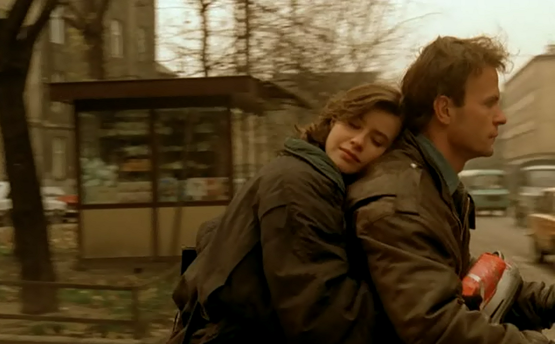
by Bengi Muzbeg
Krzysztof Kieślowski was born during the Second World War and lived in cities and towns with sanatoriums where his father received continuous treatment due to his illness. Following his father’s death at an early age, he had a difficult childhood and youth, given the conditions of the period. After failing to enter the Lodz Film School twice, he applied to the school for a third time to prove to his mother that he could do it and was accepted. It should be emphasized that from an average of 1000 applicants to the Lodz school at that time, 45-50 people reached the final stage of the exam, and only 5-6 people were accepted (Stok, 1997: 51-52).
From a young age, Kieślowski was a family-oriented person who missed his father and loved his mother and sister. He stood against the strict political system prevailing in Poland at the time and was a conscientious objector who lost 25 kilos to avoid serving in the military (Stok, 1997: 46-49). After long inspections, he managed to obtain a document for double schizophrenia, which would ensure he was not drafted into the military (Stok, 1997: 46). In other words, from his childhood, he engaged in moral questioning; he compared concepts such as soldier, weapon, execution, killing, state, oppression, censorship, and prohibition with concepts like human, ethics, spirit, emotion, morality, and honesty.
Krzysztof Kieślowski, who experienced the childhood and youth briefly mentioned above in the Poland of that era, started his career by shooting short documentaries and short films during and after his education at the Lodz Film School. Kieślowski, who did not adopt the Socialist Realist understanding of art dominant in the Soviet Union and Poland at the time, formed a movement called the “Cinema of Moral Anxiety” together with a group of directors and writers (Stok, 1997: 66-69). This effective challenge not only brought a new approach to filmmaking but also revealed a distinct form of political assertion by dismantling restrictive mechanisms. Despite this, Kieślowski did not see himself as a political figure; he saw how the Polish system, which he did not embrace at the time, transformed into a liberal system in a nationalist-capitalist sense in the 1990s and was disappointed (Stok, 1997: 61).
In this short essay, we examine how Krzysztof Kieślowski evolved from a documentary-focused film track to poetic and metaphysical cinema through four films. The main source of the text is based on the book titled “Kieslowski on Kieslowski”. Although this source is taken as a basis, other sources have also been utilized, as can be seen in the bibliography.
Camera Buff (Amator, 1979) is Kieślowski’s most self-reflexive work within the “Cinema of Moral Anxiety” movement in Poland (Güven, 2024). The story of factory worker Filip Mosz, who acquires an 8 mm camera to record his newborn daughter, goes beyond a personal hobby and turns into a test of ethical responsibility. Filip points his camera at the simple reality of life as it flows, contrary to the official discourses of the bureaucracy and the factory, and gradually begins to clash with the mechanisms of power. However, he experiences a deep moral reckoning when he realizes that the documentary visuals he shot with good intentions lead to bureaucratic sanctions and destructive consequences in other people’s lives. At the end of the film, Filip burns the film he shot and turns the lens not to the outside world but to his own face, showing that cinema is not an instrument of exhibition, but a moral threshold where the artist faces his own truth (Pekşen, 2026).
Dekalog 1 (1988), which is the most important work of the transition from social reality to moral laws, questions the boundary between the rational mind and the fragility of human life (Telek, 2023). Even though university professor Krzysztof flawlessly calculates the thickness of the ice on the lake where his son will skate with a computer, the child loses his life when the ice breaks due to unexpected melting. We know in the script of the film that waste hot water from a power station mixes into the lake, but the director removes this detail from the film and does not explain the reason for the ice breaking (Zizek, 2008: 26). Thus, he opens a cosmic mystery in the middle of the film. The tragedy of human beings who are helpless at the borders of the world of facts is accompanied by that mysterious tramp/angel figure who cannot intervene in the events but helplessly witnesses them (Zizek, 2008: 26). This angel, who resembles Jesus, will appear again and again throughout the Decalogues as an upper eye (god) or an inner eye (morality) in the position of a witness without intervening in the events.
A Short Film About Love (1988) focuses on the isolation of humans through voyeurism and passion (Stok, 1997: 181). In the story of young Tomek, who watches Magda in the opposite block with his telescope, the narrative changes perspective in the middle of the film. This perspective, which shifts from “the one who loves to the one who is loved,” makes the audience question different states of identification and empathy. The finale, which took shape with the suggestion of actress Grażyna Szapołowska and is not present in Dekalog 6, provides an opportunity for a space where modern humans, hardened by disappointments, can take refuge. Designing the end of the film in this way removes love from being a narcissistic object of desire and transforms it into an experience where individuals face their own loneliness (Zizek, 2008: 18).
As briefly emphasized above, this period coincides with a time of disappointment for Kieślowski, as he saw that the Western system was not free as supposed, that market pressure and control replaced state oppression, and he felt disillusioned by Poland’s transition to this system with a shock therapy effect after that rigid system. Perhaps because of this, Kieślowski conveys a completely intuitive and poetic story of similarity to his audience, beyond political narratives, in the film The Double Life of Veronique (1991). In this film, while the Polish Weronika passionately chooses music and loses her life on stage, the French Véronique feels this loss as an emotional ache and chooses a calm life.
Kieślowski’s cinema, instead of offering ready answers to its audience, leaves them alone with their own consciences and universal moral questions. These four films summarize human limits in the world, their mistakes, and yet their effort to reach the other, in an elegant language. Kieślowski is comfortable with not being able to please anyone in a political sense, for, it was precisely this that enabled him to build artistic, moral, and ethical values in his cinema.
References:
* Canay Güven, Z. (2024). Kieślowski’s artistic rebellion in Camera Buff (1979): Reflections on the Moral Anxiety Cinema. sinecine: Sinema Araştırmaları Dergisi, (Magazine of Cinema Research) 15(1), 143–162. [https://doi.org/10.32001/sinecine.1467355]
* Dinvar Pekşen, G. (2026). Krzysztof Kieślowski sinemasında ahlaki kaygı ve varoluş eşiği: Camera Buff / Amatör film örneği. [Moral Concern and the Threshold of Existence in Krzysztof Kieślowski’s Cinema: The Case of Camera Buff (Amator)] The Turkish Online Journal of Design, Art and Communication (TOJDAC), 16(3), 1511–1532. [https://doi.org/10.7456/tojdac.1929093]
* Stok, Darusia (1997). Kieślowski Kieślowski’yi anlatıyor [Kieślowski on Kieślowski] (Translator: Aslıhan Kutay) Afa Publishing.
* Telek, D. (2023). Sınırlı bütün olarak dünya kavrayışı: Krzysztof Kieślowski’nin televizyon dizisi Dekalog’un birinci bölümünde olgular ve değerler.[The Conception of the World as a Limited Whole: Facts and Values in the First Episode of Krzysztof Kieślowski’s Television Series Dekalog] Filmvisio, 1, 21–45. [https://doi.org/10.26650/Filmvisio.2023.0002]
* Žižek, S. (2008). Kieslowski: Maddeci teoloji [Kieślowski: Materialist Theology] (Translation: S. Gürses) Encore Publishing.